
Monster.com: Toxic Workplaces Are Worsening
"I no longer need to punish, deceive, or compromise myself. Unless, of course, I want to stay employed!"


“Toxic Workplaces Are Worsening - 80% of U.S. Workers Now Say Their Job Hurts Their Mental Health“
LOL! Monster.com!
The article is a splash of marketing masquerading as research and authored by the Monster Marketing Staff. Borrowing research-y sounding words and phrases further cloaks the actual purpose of the article: “Key findings” and “Methodology,” for example. As for their “research” conclusion: “Protect Your Well-Being — Put Mental Health First: Create your free Monster account now to take charge of your career and your peace of mind.” Translation: “Dear Reader, the quagmire of misery you’re enduring for the sake of a paycheck isn’t your fault! Join us and find the salve you seek to ease your troubled mind! The grass is greener on the other side of adding all your personal data to our database! It’s that easy!”
Crikey.
From an empirical perspective, the article is problematic for several reasons. And yet, I’m seeing articles and posts popup that link to Monster’s marketing as if it were valid research. It isn’t.
The conclusions are based on answers to survey questions. Self-reported data is always suspect. Unless rigorously designed and vetted, conclusions from survey data is rarely good for anything but the broadest of conjectures. The people most likely to respond to Monster’s survey are those who are looking to switch out of a workplace they find unsatisfying whereas people happy with their job are less likely to give such a survey any time or attention.
The sample size, 1,100 U.S. workers, is small as far as surveys go. And who are these “U.S. workers?” What specific industries are represented? What are the specific company sizes? What are the specific ages of the respondents? The survey data (including the questions) are not shared so we cannot know the answers to these and many other questions. Nonetheless, knowing the demographics of the survey respondents is critical to evaluating any conclusions drawn from the data.
Terms are not defined or described. Just what is meant by “culture” or “toxic” or “bad manager” or “growth opportunities?”
For comparison, Gallup published “The American Job Quality Study: 2025 State of the U.S. Labor Force“ that surveyed “18,000 U.S. workers across industries, demographics and employment types.” The report contains considerably more detail and includes access to the data.
The use of “toxic” in Monster’s article is nothing short of click bait. The word has been lifted from it’s original context - poisonous to our physical body - and over-applied to just about any situation that an individual finds subjectively unpleasant or upsetting. The bar for what qualifies as “toxic” has become exceedingly low. The extreme lethality of genuinely toxic substances has been diluted and normalized to “things I don’t like.” In the workplace, expecting someone to show up consistently , on time, and sober, work a full 8 hours, wear clean clothes, and being denied a $200K/year salary for an entry level position qualify for some people as “toxic.”
From a business perspective, there are many more issues with the article. A colleague of mine related a story of a direct report - a triple minority GenX’er earning well above six figures - who refused to work on an assigned project. The employee, with a straight face and lack of irony, informed my colleague that working on the project would not enhance her resume. Quelle horreur! It would be trivial to run a similarly closed survey that would likely conclude “Toxic Workplaces Are Worsening - 80% of U.S. Managers and Executives Now Say Coddled and Entitled Employees are Driving the Cost of Running a Business to the Breaking Point.” But managers and executives represent a small slice of Monster’s users, if they use the platform at all. Better to create sloppy research that appeals to the majority of customers. I get why Monster did this, but it raises my hackles anytime someone tries to freeload off the scientific process for the purpose of misleading someone else.
Bad managers, unfortunately, are a part of building a career. There is a lot of boring and unpleasant work one has to do and working under bad management is just one of the challenges. It’s been this way for thousands of years. The Peter Principle existed long before Laurence Peter described the phenomenon. People rise to “a level of respective incompetence” where they complete a metamorphosis into corporate barnacles.
My theory is everyone has a Peter Principle Plateau and embarking on a crusade to change that is a fool’s errand. You can’t change THE world, only YOUR world so better to use circumstances to develop your own resilience and capabilities as you prepare to move to the next job. Doing so pushes your personal Peter Principle Plateau higher and higher. The very best in any career constantly engage in this type of self-improvement and consequently continually push their personal plateau ever higher, keeping it far out of reach. If you’ve done it right, you’ll never have to see the world from the corporate barnacles’ view.
I’ve worked in a lot of industries and workplaces during my working years and there were bad managers in every single one of them. What has changed, however, is in the past I was part of an employee base that was much more resilient and responsive in the face of workplace adversity. Today, it’s a well substantiated fact that, in general, younger generations are far more obsessed with mental health issues than was the case with older generations when they were young and beginning careers. This would be a good thing if the idea of “health” hadn’t been turned on it’s head by identity politics.
To this point, Monster’s article may be on to something: “Among those with poor or fair mental health, 51% say their well-being would improve if employers removed toxic employees.” The percentage of employees that are making the workplace toxic for everyone else has increased.
I asked Grok: “For each edition of the ‘Diagnostic and Statistical Manual of Mental Disorders‘ (DSM), how may unique psychological diagnosis and pages did each contain?”
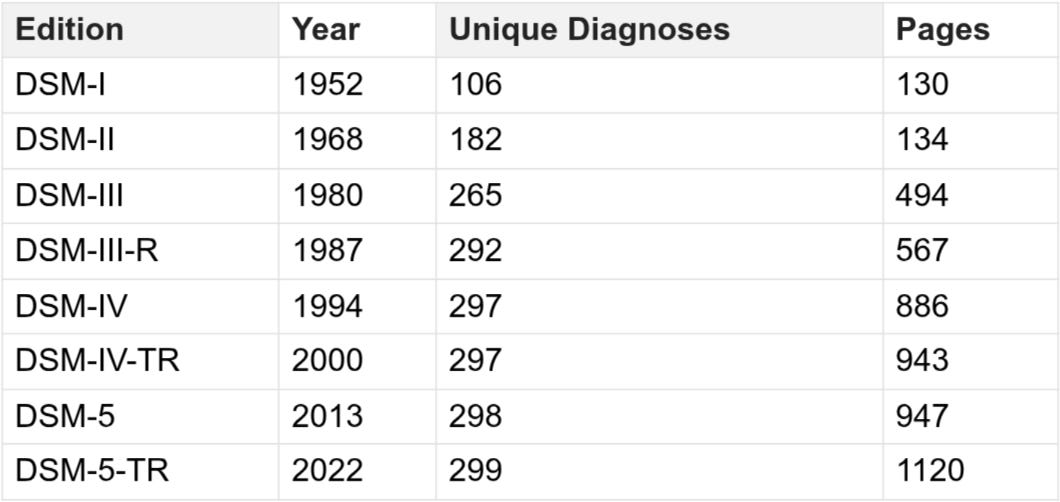
There are good aspects to the trend of increased awareness regarding mental health, but it seems to me the downsides have been much greater. Efforts to improve one’s lot in life and rise above common challenges have been replaced with an obsession to define one’s self as unique a needy victim as possible and so expect the world change to accommodate their shortcomings. The DSM serves as a veritable menu for young people to peruse as they search for a suitable identity with which to bludgeon the world around them and insulate them from responsibility and accountability. This is a profound disservice to those who are truly in need of help.
Globally, we live in the most affluent time in history where most people in the Western world need not worry about basic survival. Opportunities to thrive are abundant. But everyone still has to figure out a way to leverage opportunities for themselves. For too many among the younger generations, they’ve been raised to expect that they need not work for rewards and that obstacles to happiness and financial security will be provided by others. It doesn’t help that ambition seems to be at an all time low. They lack the skills for interacting with and learning from the Cruelly Indifferent Universe in a way that leads to mental health, rather to mental illness.
A long string of good times has lead to this and as things continue to tighten up in the white-collar workplace, mental immaturity will be exposed in a generation that hasn’t learned how to cope let alone adapt. In Anti-Agile Workplaces I noted how college campus culture looks more like daycare and less like scholarship and truth-seeking. I could say something similar about many workplaces I’ve encountered: They look and operate more like daycare than places of productivity and achievement. But there’s plenty of blame to spread around for this: helicopter/snowplow parenting, public education’s focus on teaching-to-the-test and obsession with unsubstantiated education theories and woke/identity ideology, social media algorithms...the list is long.
Putting the burden for solving this on the employer, as Monster’s article recommends, and making the workplace “mentally healthy” for everyone is an unattainable goal. It does nothing other then add another layer to the problem and move us further from addressing core issues.
Monster.com - Toxic Workplaces Are Worsening” last updated on 2025.10.26.
I hope you will return regularly to The Remnant’s Way as I often update posts, particularly Ab Initio, and do not always publish to email posts that are meant to support or serve as reference to existing or future posts.
And please consider becoming a paid subscriber. Doing so supports my writing efforts and grants me the most precious of all resources - dedicated time for writing. And for that, I am deeply grateful. If you prefer, buy me a cup of coffee if there is an article here and there that you enjoyed or found valuable.
Image credit: Grok 4